Show me courses.
Graduate Courses
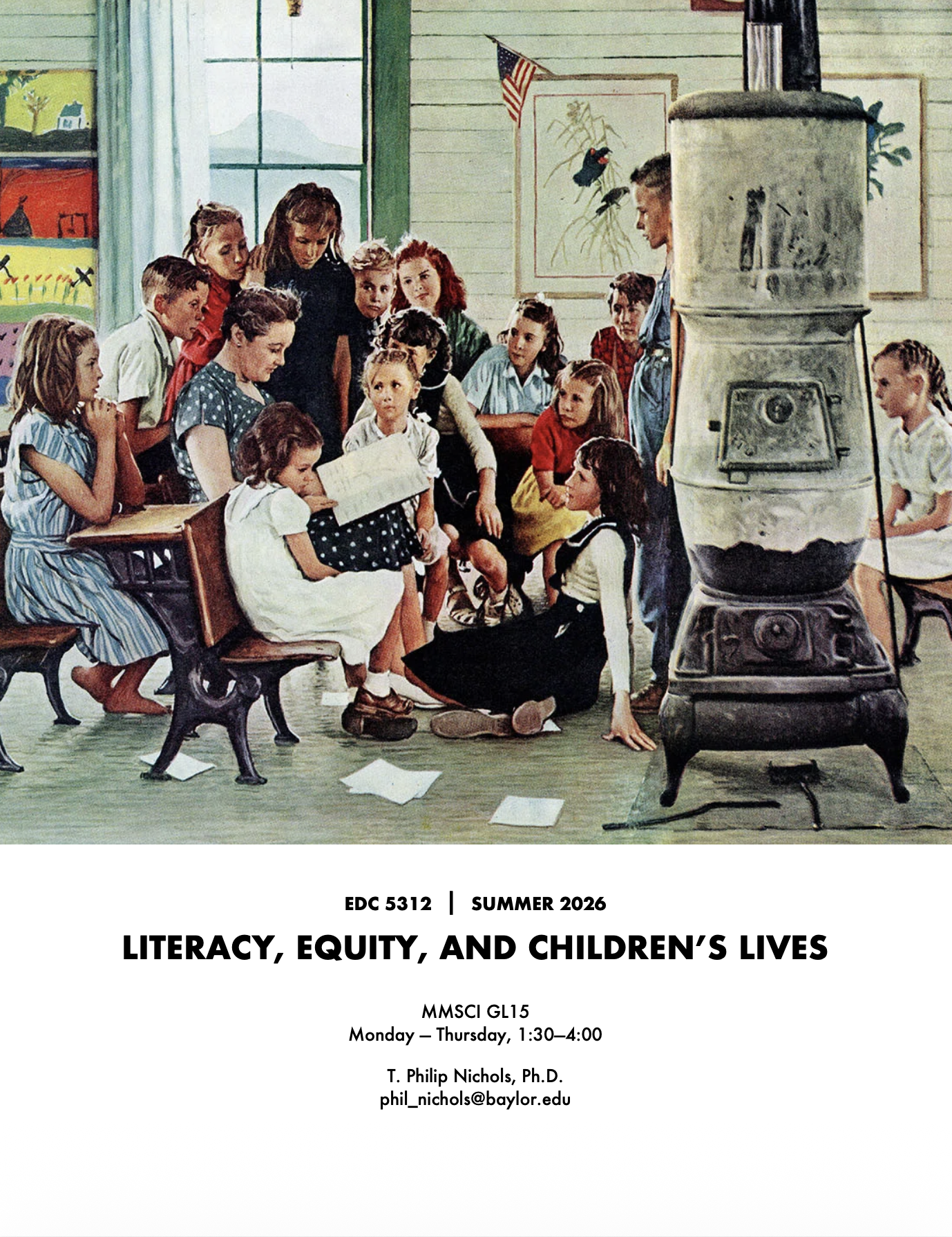
EDC 5312
Literacy, Equity, and Children's Lives
This course examines “literacy” as a contested concept — one that carries different meanings across contexts, traditions, and political moments, and that shapes children's lives in ways extending well beyond the technical skills of reading and writing. Many students arrive in graduate work with a firm sense of what literacy is and what it means to teach it; the course is designed to complicate that sense, drawing on scholarship that treats literacy as a social phenomenon situated in particular cultures, histories, and power relations rather than as a neutral skill that operates the same way for everyone. Across four weeks it moves through four interrelated frames: literacy as ideological and identity-bound (Situating Literacy), as plural and expansive (Expanding Literacy), as institutionalized in policy (Governing Literacy), and as a site of pedagogical inquiry (Teaching Literacy). The arc is cumulative, each week building on and complicating the one before.
EDC 5313
Media Literacy across the Curriculum
“Media literacy” is commonly associated with teaching students to find, interpret, and produce information across a range of media technologies — positioned on one hand as a resource for protecting young people from misinformation and the corrosive influence of new technologies, and celebrated on the other as a way to empower students to critique media systems and produce their own messages. The term has recently come under scrutiny, as scholars question whether a focus on individual interpretive, critical, or creative practice is suited to the scale and intricacy of the challenges today's media environments pose. The course takes up those questions across four sections: theories of literacy and media; media pedagogies that have found resonance in education studies; the present uncertainties surrounding the concept itself; and possibilities for future research, teaching, and practice.
EDC 5326
A Process Approach to Teaching Writing
What does it mean to “teach writing”? It is a deceptively simple question — the kind that begins to unravel as soon as it is scratched. Is writing a product or a process? Does it pertain only to alphabetic text, or to other expressive modes as well? And what is it we teach when we teach it: skills for the literacy demands of college and work, an expressive literary voice, communicative strategies for civic life? How we answer shapes our approach to curriculum and instruction. This seminar treats such answers as stories — the narratives that hold together our own and others' theories of writing and that, as Toni Morrison suggests, condition us in turn, both as writers and as teachers of writing. We interrogate the ideas underpinning historical and contemporary notions of composition while engaging in familiar and unfamiliar forms of writing, working toward alternate “writing stories” that might make teaching and learning more meaningful.
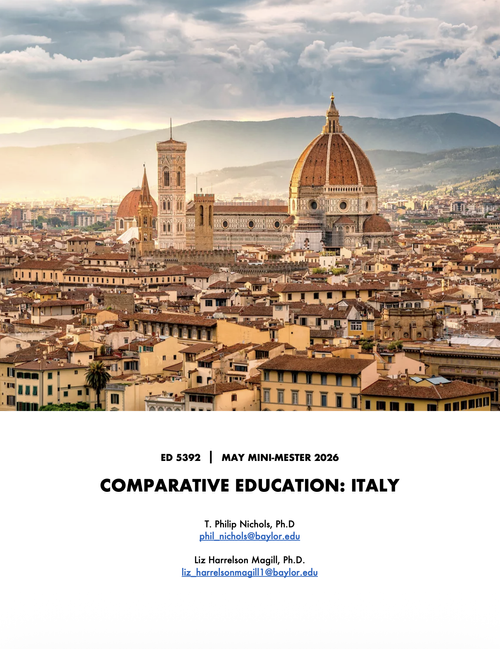
EDC 5349
Comparative Education: Italy
Comparative Education examines the value, and the limits, of comparison for understanding education. The course explores comparative perspectives on foundational aspects of schooling and considers how local and national systems answer shared questions about teaching and learning in different ways. These perspectives are not held in the abstract: the course culminates in an immersive experience in Italy, with visits to schools and universities, conversations with professors, teachers, and students, and sustained reflection on what those encounters suggest about our own educational system, school sites, and classroom practices.
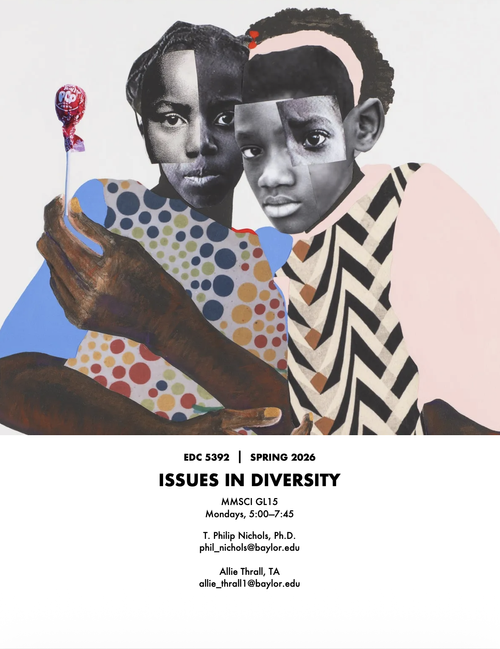
EDC 5392
Issues in Diversity
This course examines issues of “diversity” and their implications for research and instructional practice across educational settings. Its focus draws attention to race, gender, class, and other formations of human difference as they are situated in U.S. society and its educational institutions. Many of the topics fall under the heading of multicultural education and together form a foundation for examining questions of risk, access, and equity in schools.
EDC 6311
Fundamentals of Curriculum
What is curriculum? A commercial program or a sequence of unit plans, certainly — but also the less visible elements that determine what gets taught and learned in classrooms: state standards, content-area conventions, district policies, school resources, systemic inequities, student identities. These may not be tied to any planned sequence of instruction, yet they condition what students are encouraged to think and do and be in school. Understood this way, curriculum is less a plan to be followed than an environment to be navigated — a constellation of competing interests directing learning toward contradictory ends. How that constellation forms, who shapes it, and how it might be organized otherwise are the questions of Curriculum Studies. The course examines historical and contemporary approaches to curriculum, focused on K–12 contexts but attentive to how experiences outside school bear on those within, and to the stakes of these abstract questions for policy, research, and practice.
EDC 6358
Design Research
This course explores the theory and use of design-based methods in education research. Where many qualitative and quantitative approaches emphasize observation and description of educational phenomena, design research is distinguished by its focus on intervention — the integration of empirical data into the iterative engineering of learning environments and experiences. Over the past two decades scholars and practitioners have increasingly turned to it to study and refine new curricula, instructional approaches, technologies, and school reforms. Through readings, discussions, activities, and demonstrations, students encounter a range of design-based approaches and receive guidance in shaping and proposing a project of their own, attending throughout to the possibilities, limitations, and ethical considerations of the method.
EDC 6390
Advanced Qualitative Methods
This doctoral seminar examines the theoretical and practical issues involved in designing, conducting, and writing up qualitative research. Building on principles from EDC 6336, it takes up advanced strategies for investigating research questions across a range of qualitative methods — ethnography, case study, discourse analysis, design-based research — alongside approaches to organizing and analyzing data, writing findings for particular audiences, and reflecting on questions of power, positionality, and ethics.
Undergraduate Courses
TED 3380
Social Issues in Education
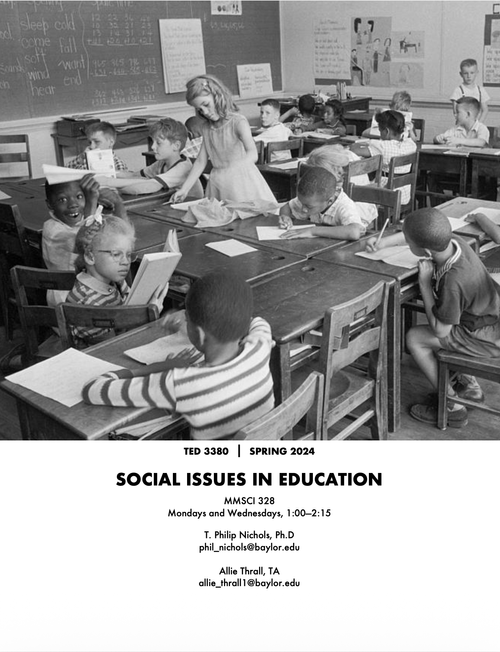
This course examines the structures of schooling in relation to historical and contemporary inequities. Working from a justice-oriented framework, students consider what it might mean for educators to adopt a stance of culturally relevant, sustaining, and affirming pedagogy in today's classrooms. Research, analysis, and varied forms of cultural engagement provide the foundation for understanding how educators can meet the needs of all students in classrooms alive with difference — in language and culture, identity and ability.
TED 3396
Secondary ELA Methods
A methods course preparing preservice English teachers to plan and deliver instruction that meets the needs of diverse learners. Students become familiar with state standards and develop approaches to assessment, planning, and instruction, working with culturally and developmentally responsive techniques and materials. Coursework runs alongside school-based field experience, so that methods introduced in class are tested and revised in practice.
LS 4320
Young People's Literature
A collaborative exploration of the contexts, purposes, and uses of adolescent literature. Students read and analyze primary texts written for young adults alongside secondary sources that illuminate the questions those books raise: what “adolescence” is and what constitutes adolescent literature; what literary value YA holds and how it relates to conventional “classics” or the canon; how the form and content of the genre are evolving; why young people read it; whether its subjects should be constrained; and what it means to teach YA literature in formal and informal educational settings.